Elysia 1.3 and Scientific Witchery
Written by saltyaom – 5 May 2025
Named after the song https://youtu.be/d-nxW9qBtxQ by Mili.
This release doesn’t bring shiny new features; it’s all about refinement to make things better to the point that we consider it as “magic.”
Elysia 1.3 introduces near‑0 overhead normalization, a Bun system router, a standalone validator, half the type instantiations, and significant memory usage reduction and faster startup time for large apps.
Table of Contents
- Exact Mirror
- System Router
- Standalone Validator
- Reduced Type Instantiation
- Performance Improvement
- Validation DX Improvement
- Status
- “.index” is removed from Treaty
- Notable changes
- Afterword
Exact Mirror
We introduced normalize in Elysia 1.1 to ensure that data matches our desired shape, and it works nicely.
It helps reduce potential data leaks, unexpected properties, and our users love it. However, it comes with a performance cost.
Under the hood, it uses TypeBox.Value.Clean to coerce data into a specified schema dynamically.
It works great but isn’t as fast as we want it to be.
Because TypeBox doesn’t offer a compiled version ofValue.Clean(unlikeTypeCompiler.Checkwhich leverages compile‑time knowledge).
That’s why we introduced a replacement with Exact Mirror.
Performance
For small objects without arrays we measured up to ~500× faster for the same object.
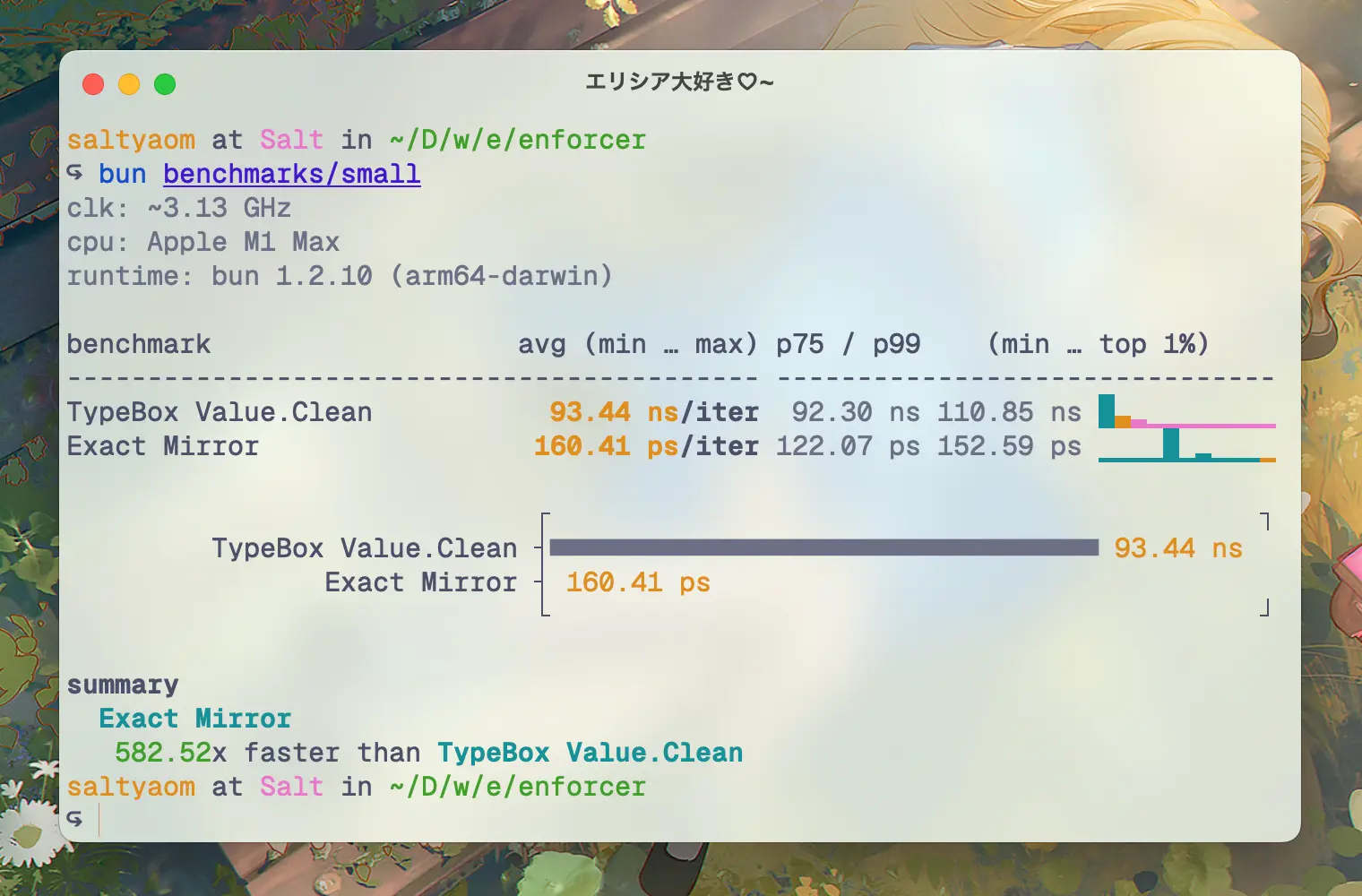
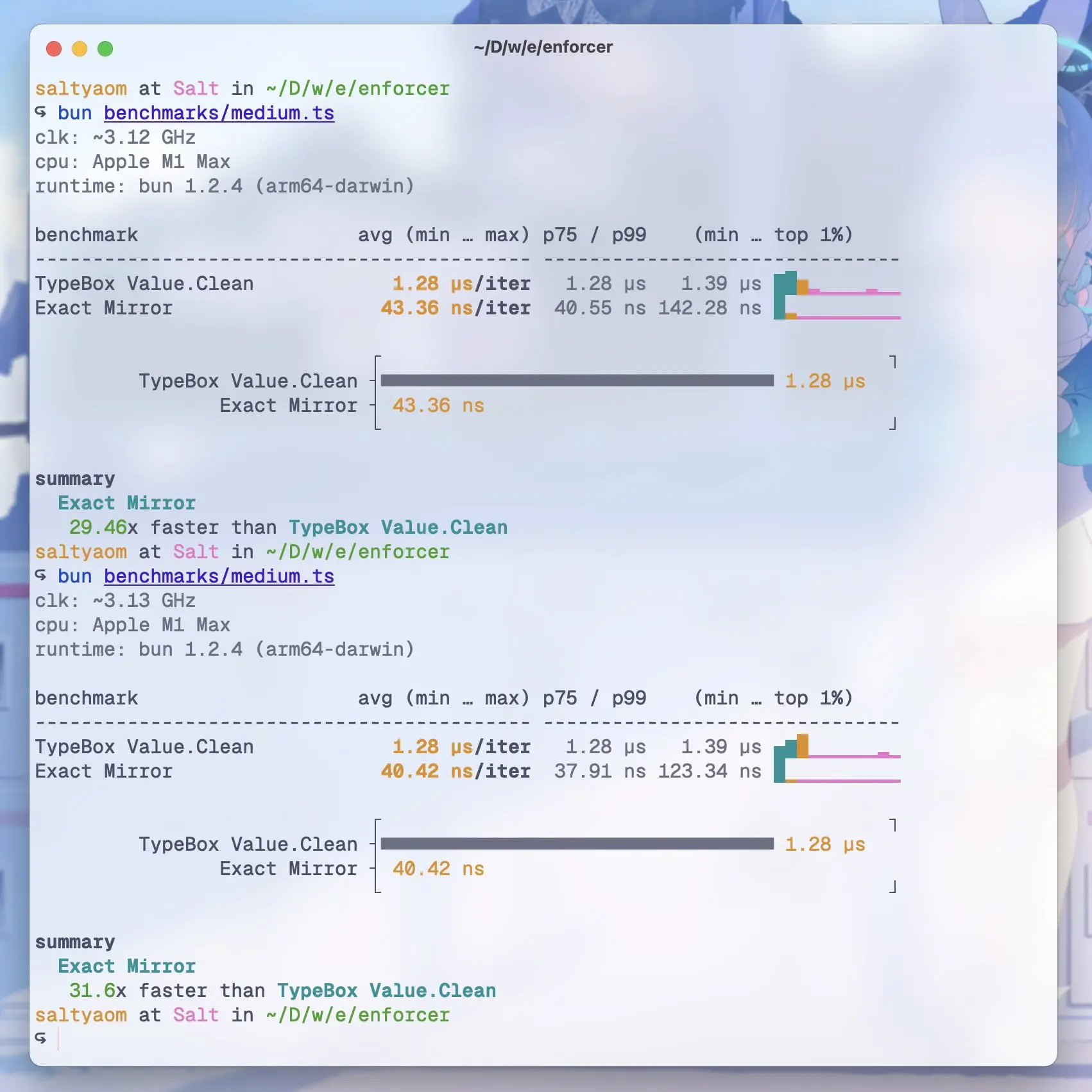
And for medium‑ and large‑size objects, we measured up to ~30× faster.
What it means for Elysia
Starting from Elysia 1.3, Exact Mirror is the default strategy for normalization, replacing TypeBox.
By upgrading to Elysia 1.3, you can expect a significant performance improvement without any code changes.
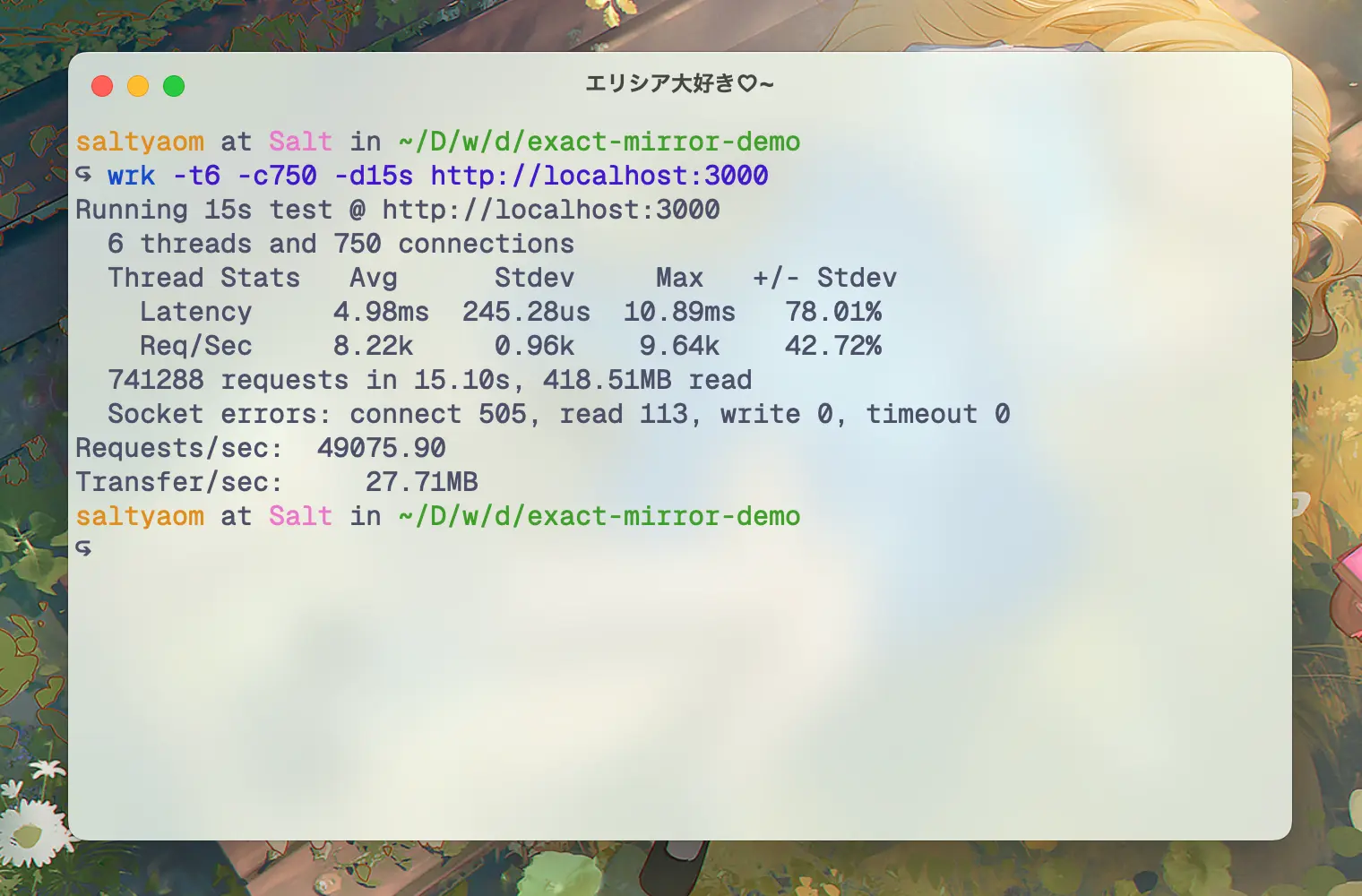
Here’s the throughput on Elysia 1.2 (normalization turned off).
And here’s the same code on Elysia 1.3 (normalization turned on).
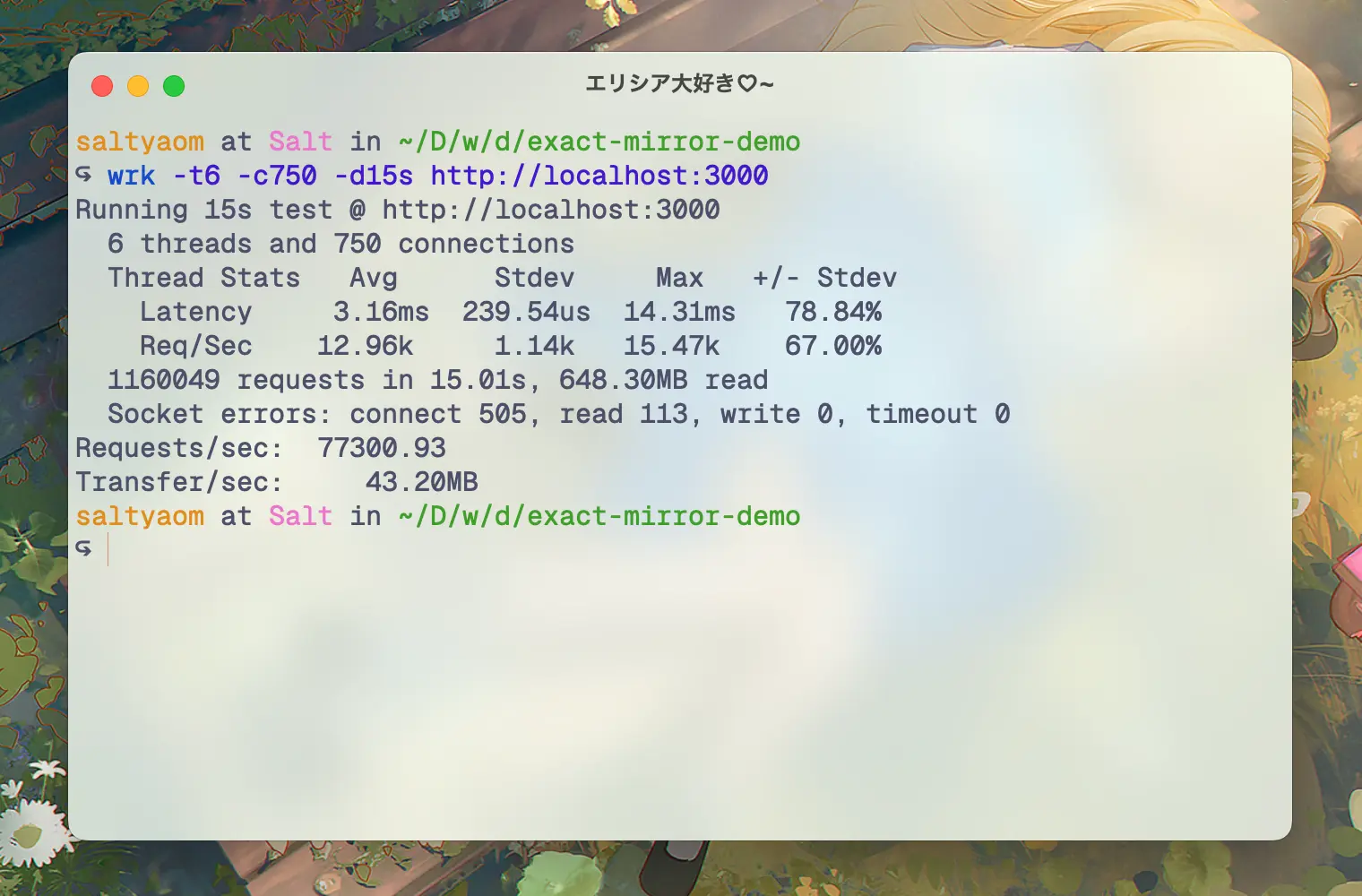
We measured up to ~1.5× throughput when using a single schema with normalization.
If you use more than one schema, you should see even more improvement.
When comparing to the same code without schema, we see < 2% performance differences.
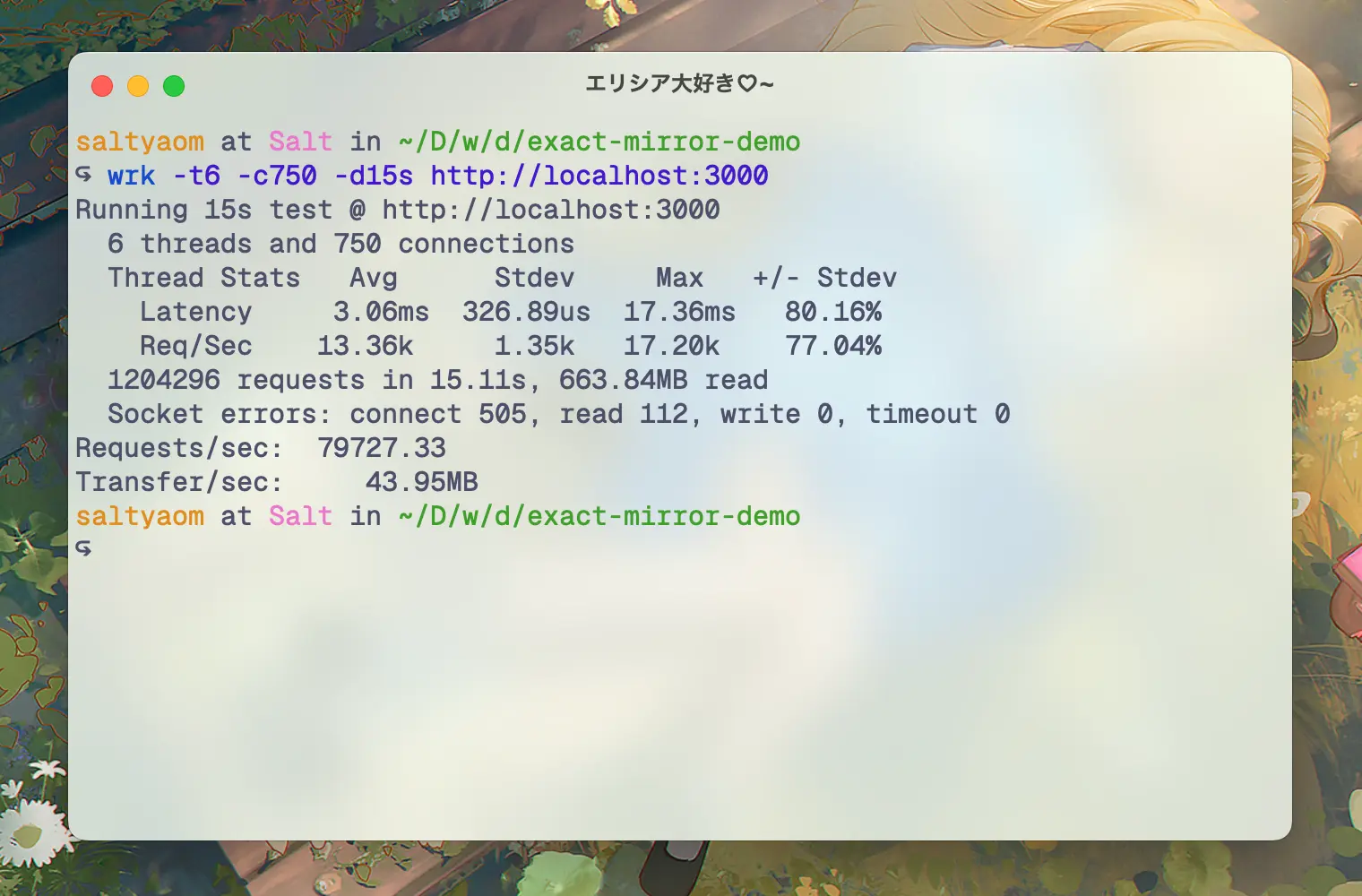
This is huge. Previously you had to choose between safety and performance, but now you don’t have to worry about it.
The validation overhead is dropped to almost zero without any changes on your side.
If you’d like to use TypeBox or disable normalization entirely, you can set it with the constructor:
import { Elysia } from 'elysia'

new Elysia({
  normalize: 'typebox' // Using TypeBox
})
You can try the benchmark yourself by visiting the Exact Mirror repository.
System Router
We have never had performance problems with router in Elysia.
It has excellent performance, and we hyper‑optimised it as much as we possibly can.
Bun Router
Bun 1.2.3 offers a built‑in solution to routing (possibly) in native code.
For static routes, we didn’t see much performance improvement, but dynamic routes perform 2‑5% faster without any code changes.
Starting from Elysia 1.3, we offer a dual router strategy by using both Bun’s native router and Elysia’s router.
Elysia will try to use a Bun router if possible and fall back to Elysia’s router.
Adapter
To make this possible, we rewrote our internal compilation code to support a custom router from an adapter.
This means that it’s now possible to use a custom router alongside Elysia’s own router.
This opens up an opportunity for performance improvement in some environments, for example: using built‑in uWebSocket.js router which has a native implementation for routing.
Standalone Validator
In Elysia, we can define a schema and apply it to multiple routes with guard.
We can then override a public schema by providing a schema in a route handler, which sometimes looks like this:
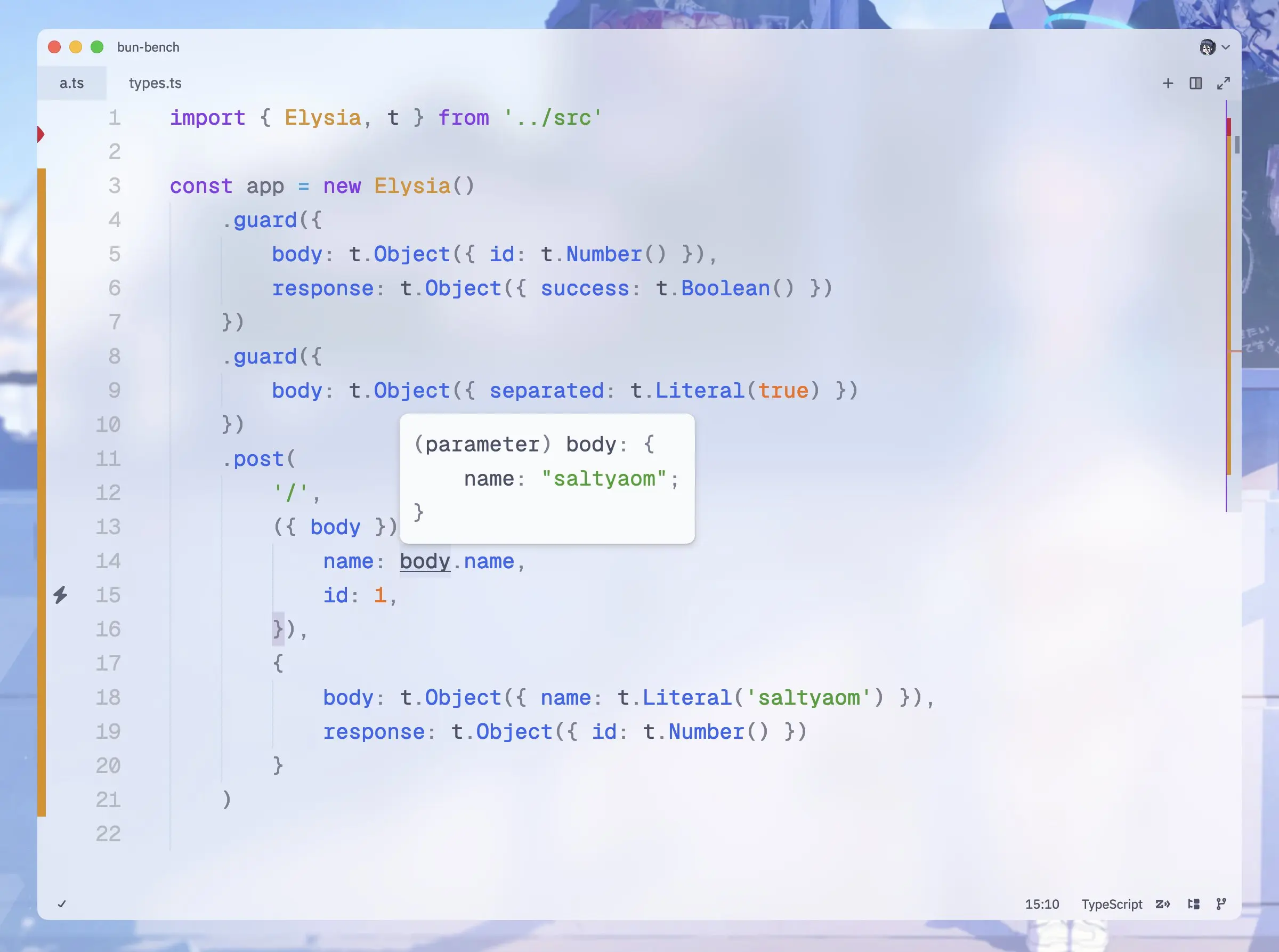
Elysia run with default override guard
But sometimes we don’t want to override a schema.
Instead we want it to work both allowing us to combine schemas instead of overriding them.
Starting from Elysia 1.3, we can do just that.
We can now tell Elysia not to override it and instead treat it as its own by providing a schema as standalone.
import { Elysia } from 'elysia'

new Elysia()
  .guard({
    schema: 'standalone', // <‑‑ added
    response: t.Object({
      title: t.String()
    })
  })
As a result, we have results that are like merging a local and global schema together.
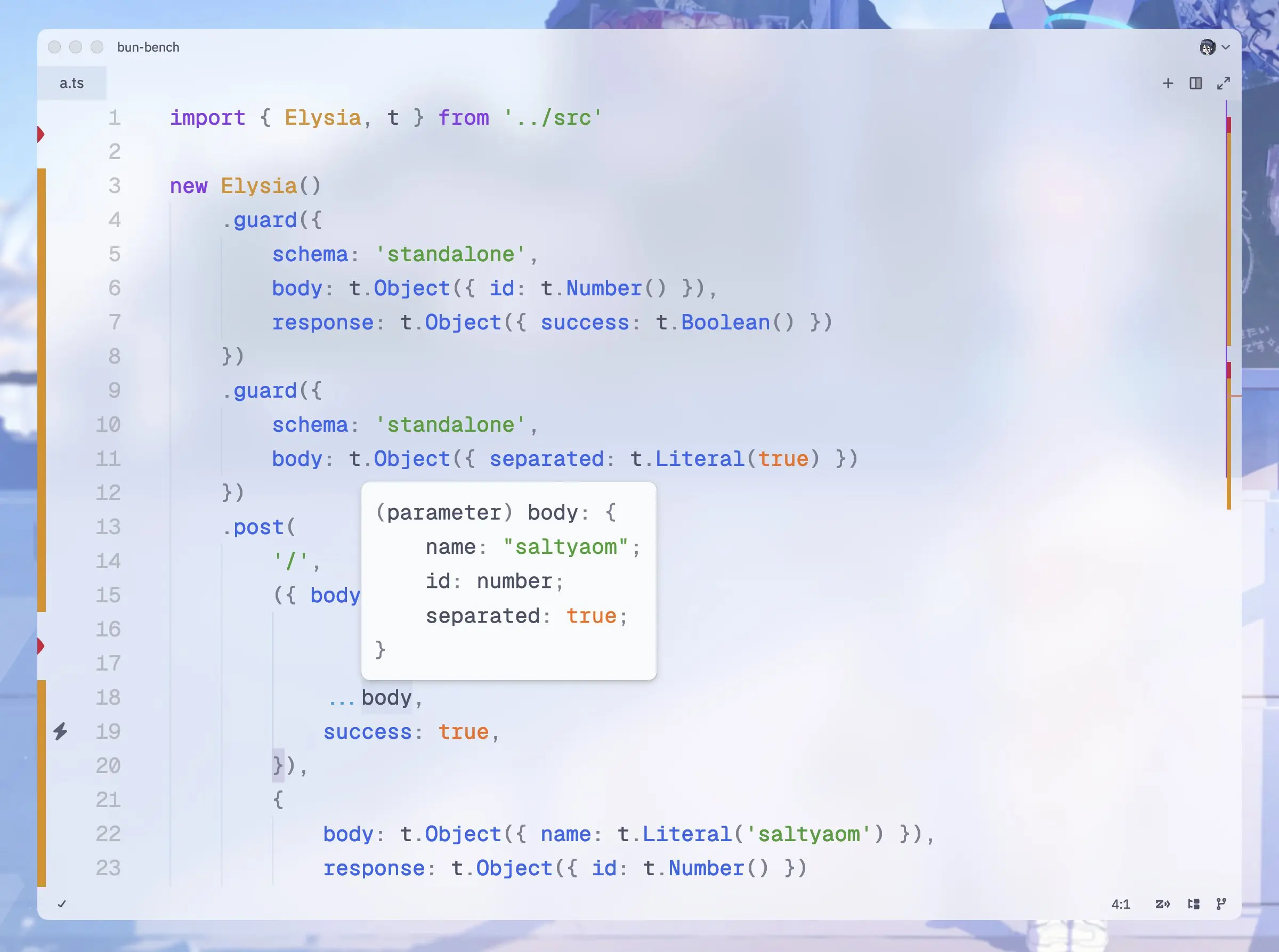
Elysia run with standalone merging multiple guard together
Reduced Type Instantiation
Elysia’s type inference is already extremely fast.
We are really confident in our optimisation of type inference and it’s faster than most frameworks that use an express‑like syntax.
However, our users with really really large scale applications with multiple routes and complex type inference managed to reduce type instantiation by half in most cases, and measured up to 60% improvement in inference speed.
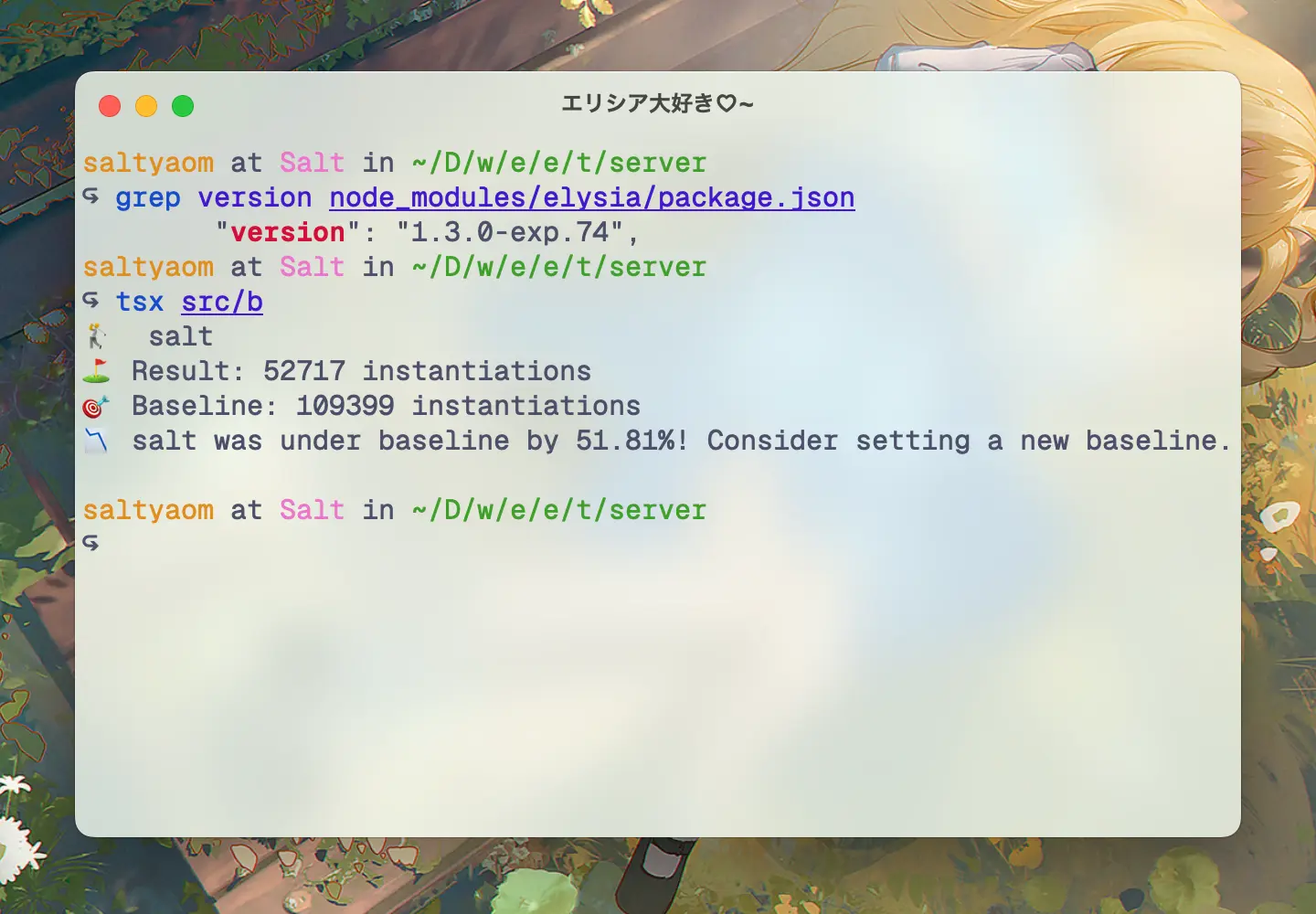
type instantiation reduced from 109k to 52k
We also changed the default behaviour of decorate instead of looping every object and property recursively to do intersect instead.
This should solve the problem with users who use heavy object/class for example PrismaClient.
As a result, we should end up with faster IDE auto‑completion, suggestion, type checking and Eden Treaty.
Performance Improvement
We have refactored and optimised a lot of internal code which accumulates up to significant improvements.
Route Registration
We refactored how we store route information and reuse an object reference instead of cloning/creating a new one.
We saw the following improvements:
- Up to ~5.6× reduced memory usage
- Up to ~2.7× faster route registration time
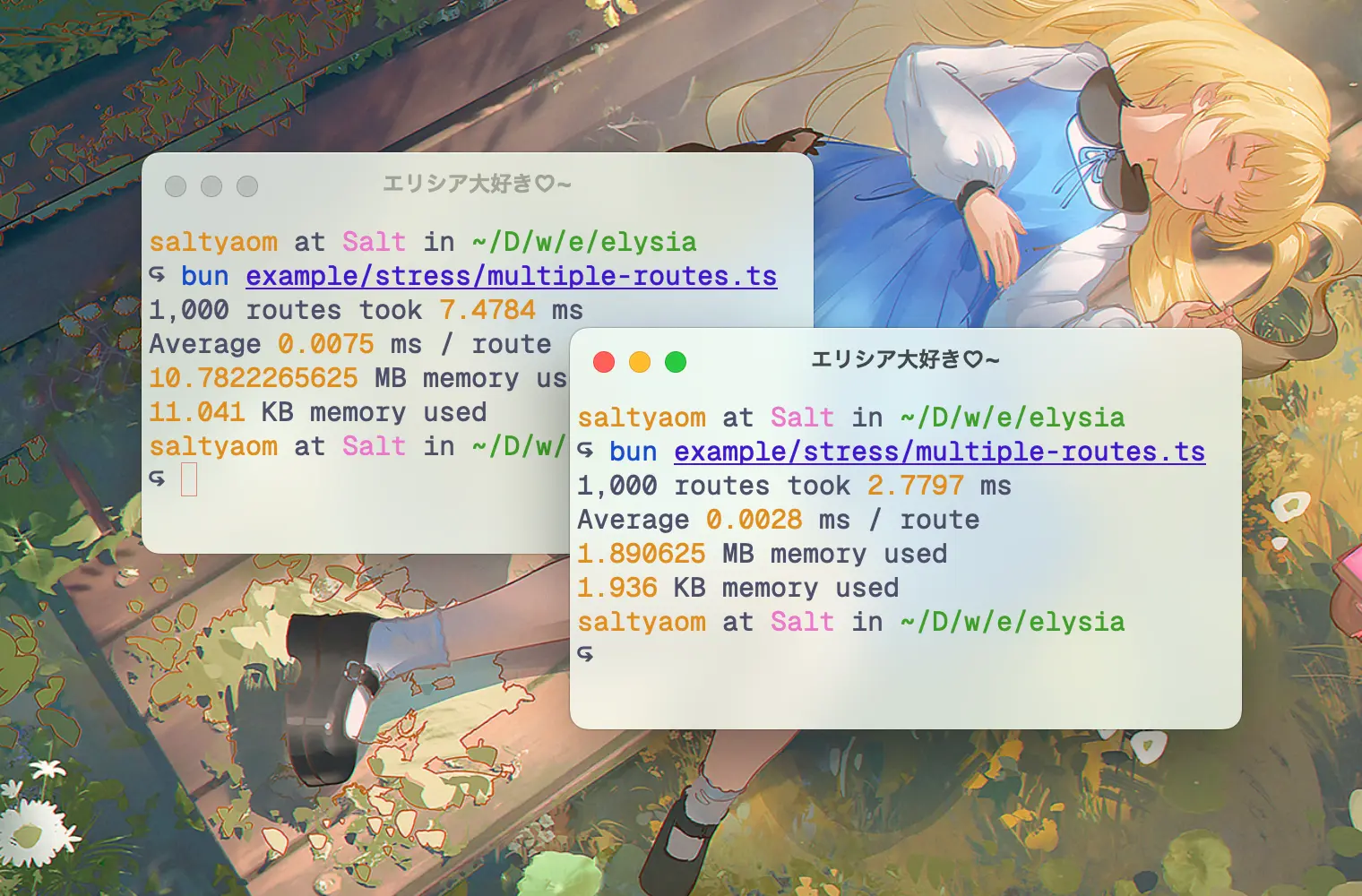
Route registration comparison between Elysia 1.2 (left) and 1.3 (right)
These optimisations should show real results for medium to large scale apps as it scales with how many routes the server has.
Sucrose
We implemented Sucrose cache to reduce unnecessary re‑computation and reuse compiled routes when compiling each route for non‑inline events.
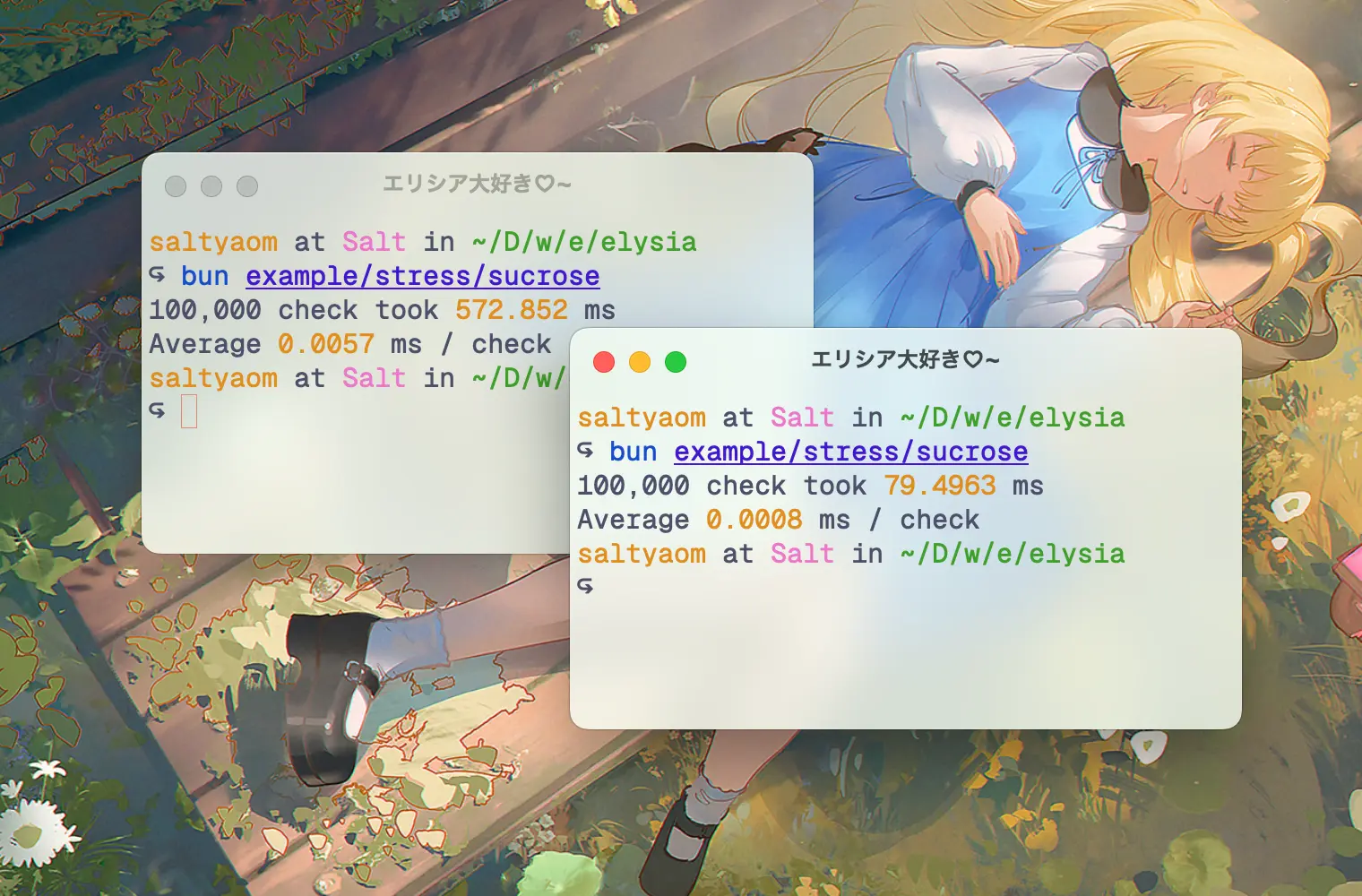
Sucrose performance comparison between Elysia 1.2 (left) and 1.3 (right)
Sucrose converts each event into a checksum number and stores it as a cache. It uses little memory and will be cleaned up once the server has started.
This improvement should help with the startup time of each route that reuses global/scoped events.
Instance
We saw a significant improvement when creating multiple instances and applying them as plugins.
- Up to ~10× reduced memory usage
- Up to ~3× faster plugin creation
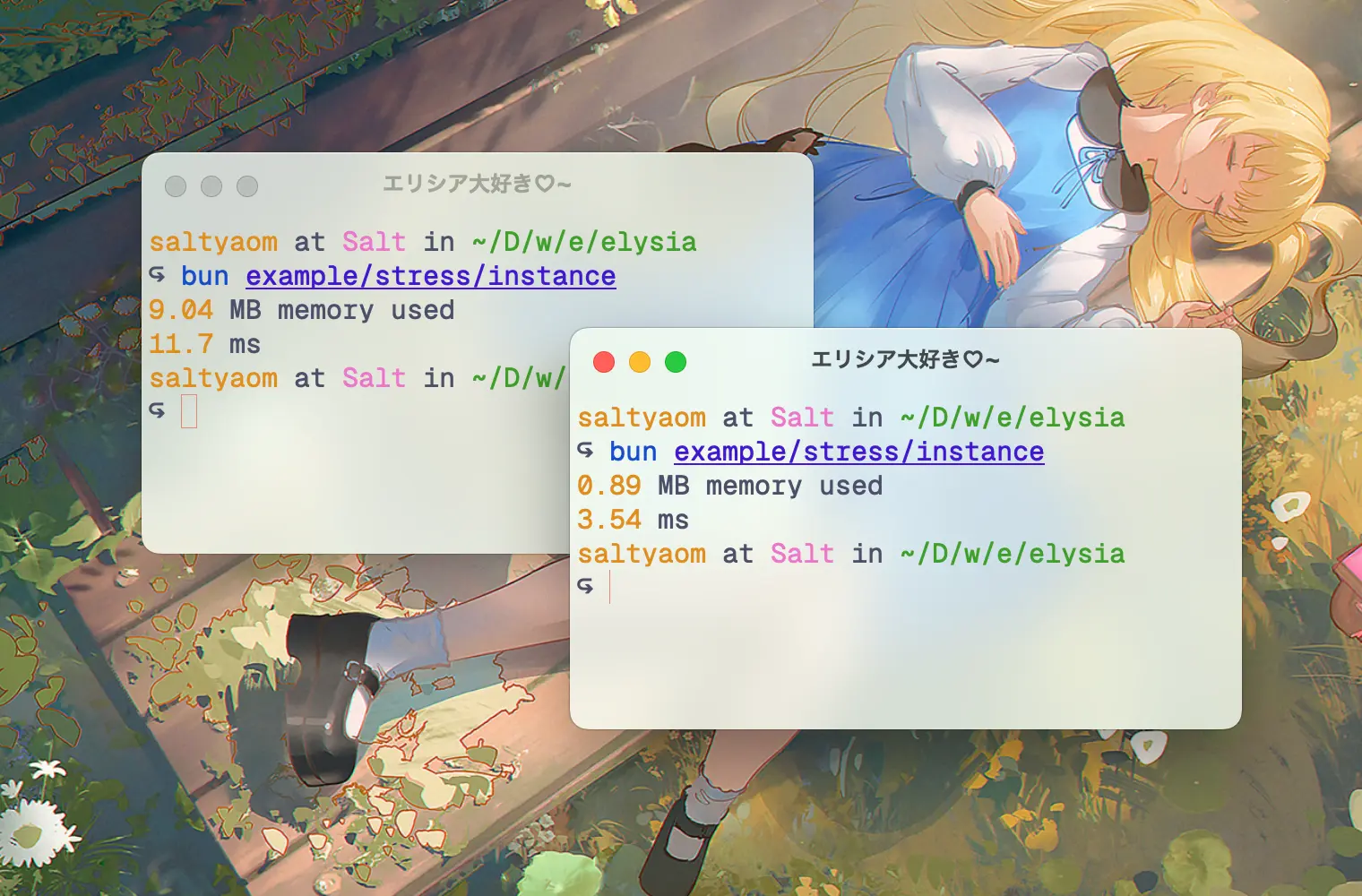
Elysia instance comparison between Elysia 1.2 (left) and 1.3 (right)
These optimisations will be applied automatically by upgrading to Elysia 1.3. However, these performance optimisations might not be significantly noticeable for small apps.
Serving a simple Bun server has a fixed cost of around 10‑15 MB. These optimisations are more about reducing existing overhead and improving startup time.
Faster performance in general
Through micro‑optimisations, fixing technical debt, and eliminating unused compiled instructions.
We saw some general improvements in Elysia request processing speed. In some cases up to 40%.
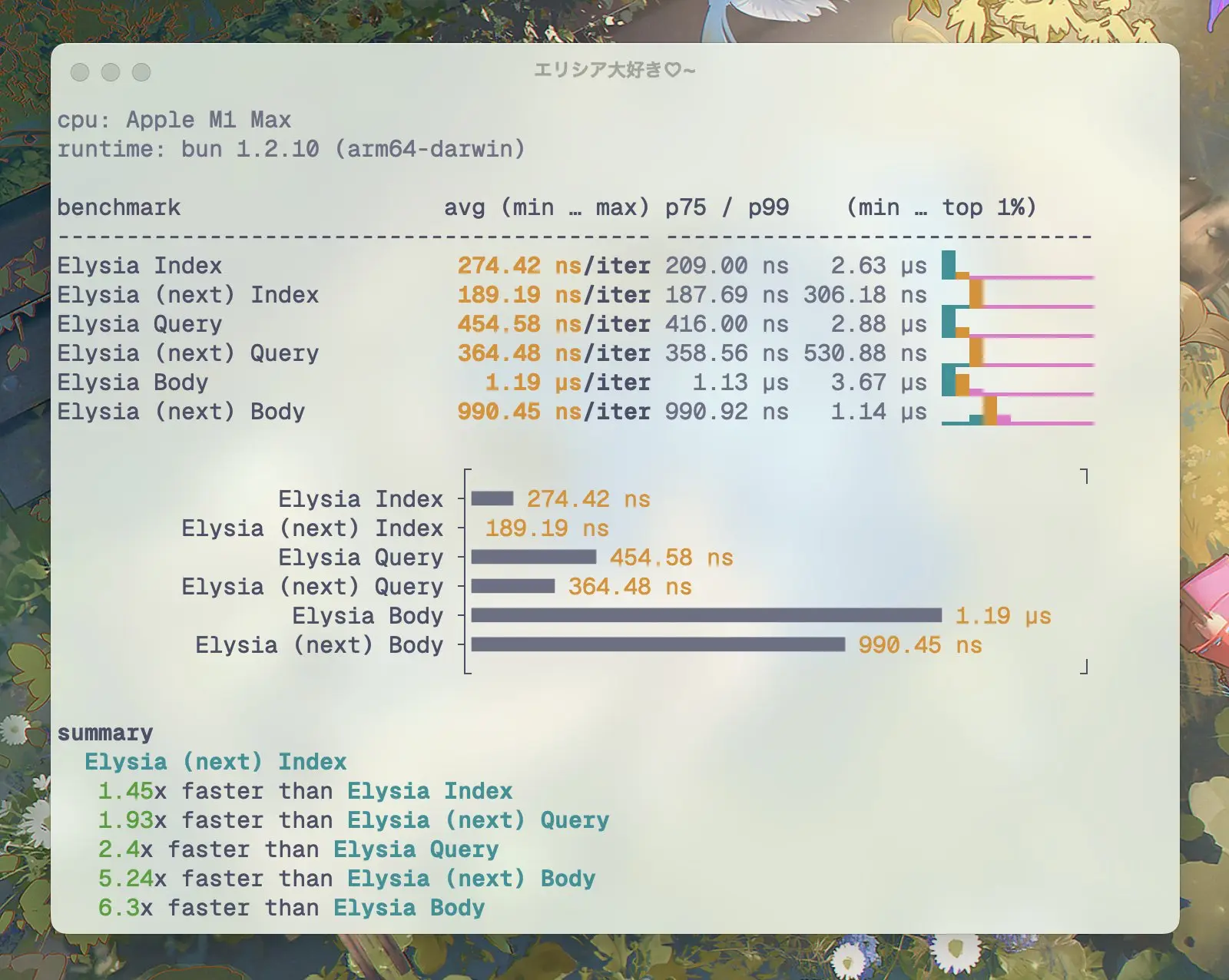
Elysia.handle comparison between Elysia 1.2 and 1.3
Validation DX Improvement
We want Elysia validation to just work.
The one that you can just tell what you want and get it. It’s one of the most valuable aspects of Elysia.
In this update, we have improved some areas that we have been lacking.
Encode schema
We moved encodeSchema out of experimental and enabled it by default.
This allows us to use t.Transform to apply custom response mapping to return to the end user.
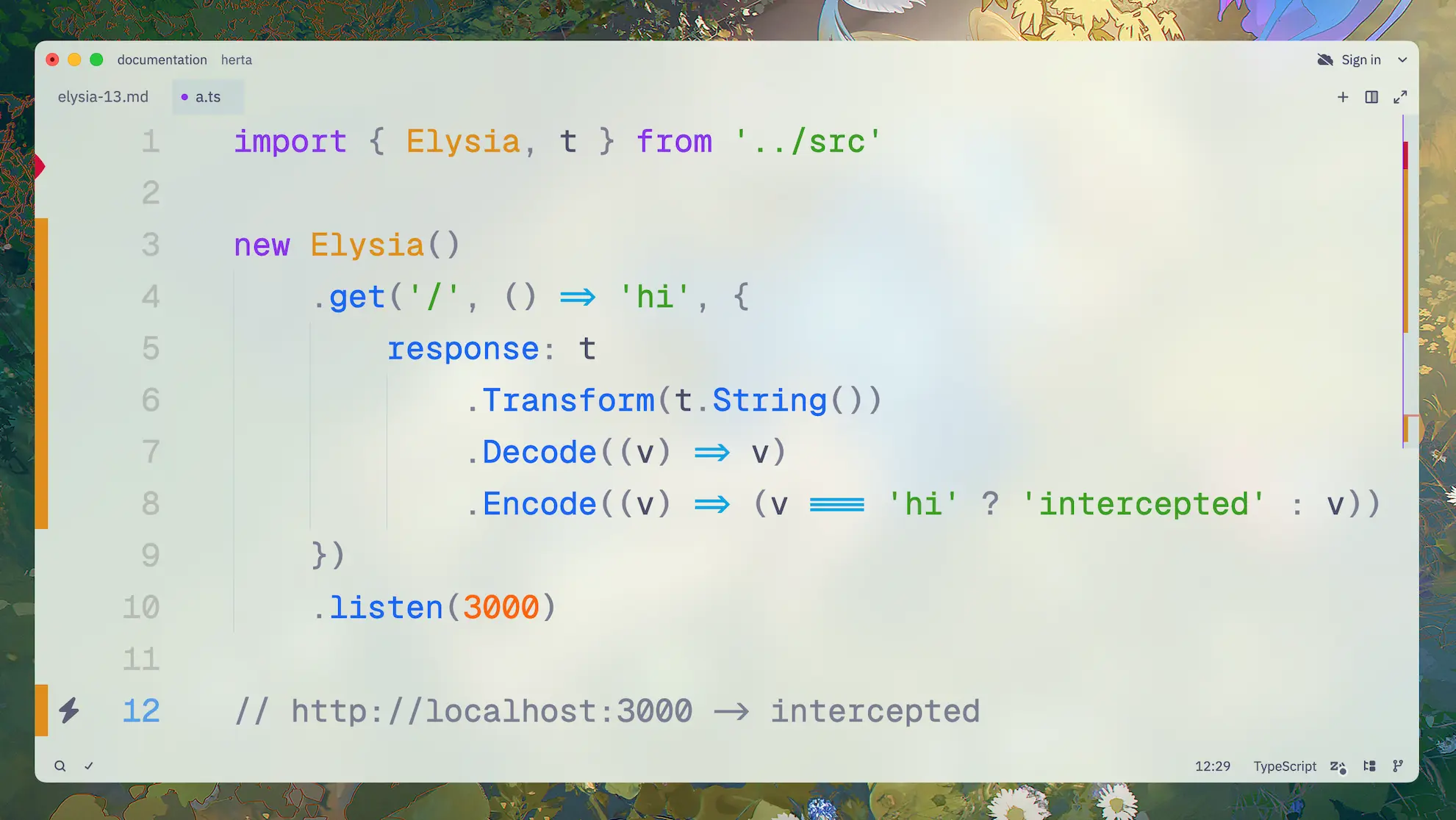
Using t.Transform to intercept a value into a new one
This example will intercept a response, replacing “hi” with “intercepted” instead.
Sanitize
To prevent SQL injection and XSS, and to ensure string input/output is safe, we introduced sanitize option.
It accepts a function or an array of functions that intercepts every t.String, and transforms it into a new value.
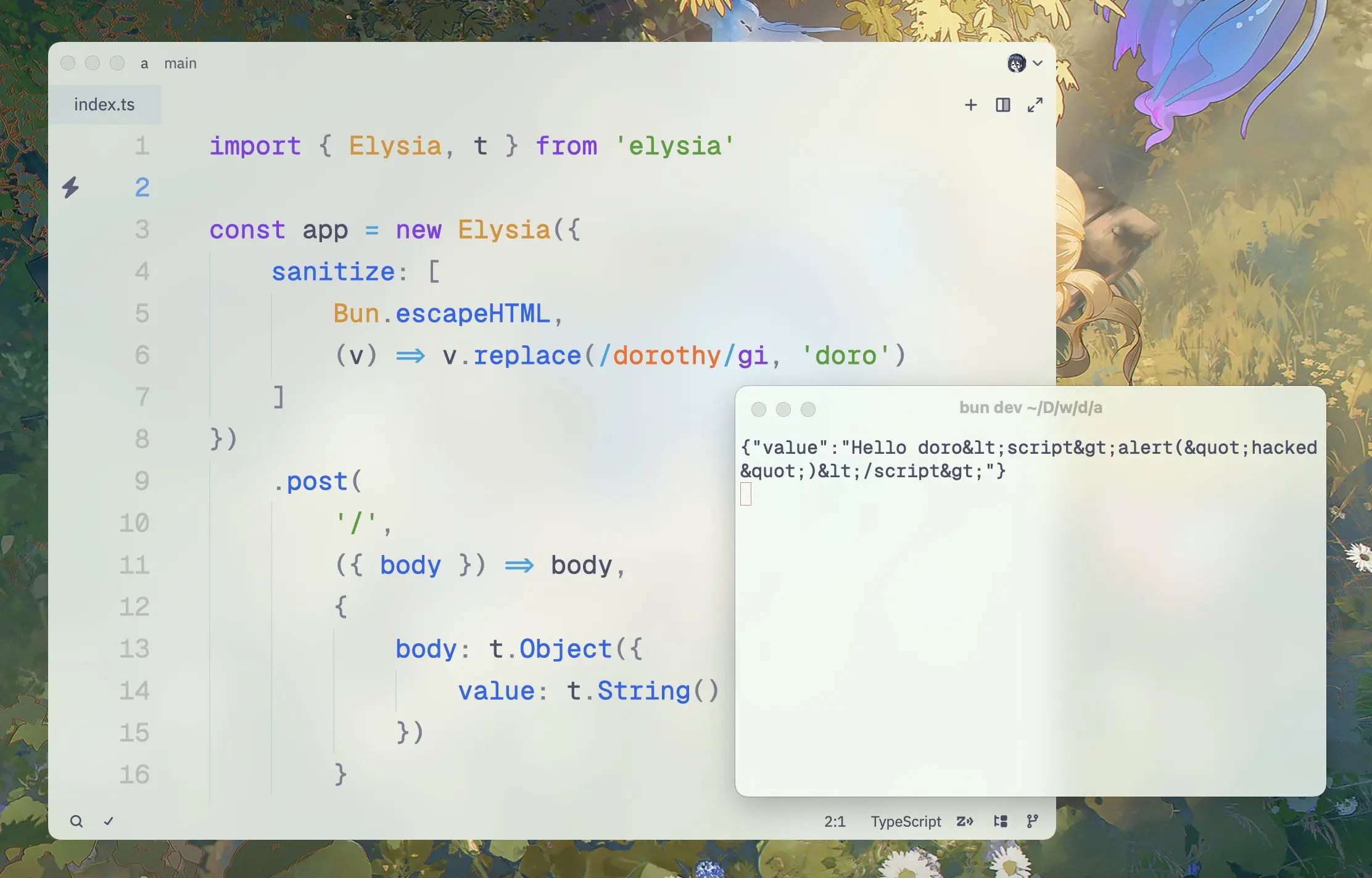
Using sanitize with Bun.escapeHTML
In this example, we are using Bun.escapeHTML and replace every “dorothy” with “doro” instead.
As sanitize will apply to every schema globally, it must be applied on a root instance.
This should greatly reduce the boilerplate to safely validate and transform each string field manually.
Form
In previous versions of Elysia, it’s not possible to type‑check FormData response with form and t.Object at compile time.
We have now introduced a new t.Form type to fix that.
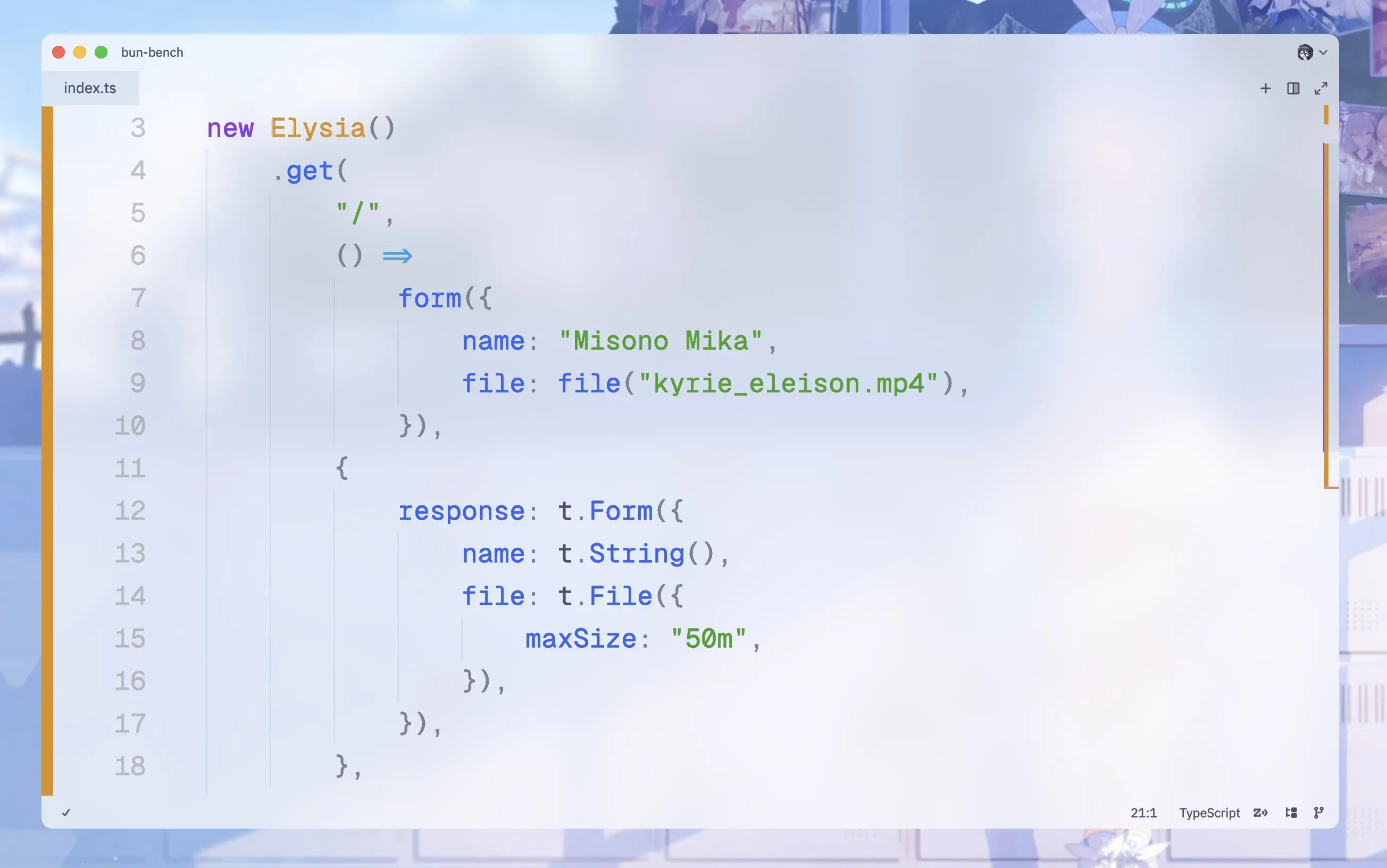
Using t.Form to validate FormData
To migrate to type‑check form, simply replace t.Object with t.Form in response schema.
File Type
Elysia now uses file‑type to validate file type.
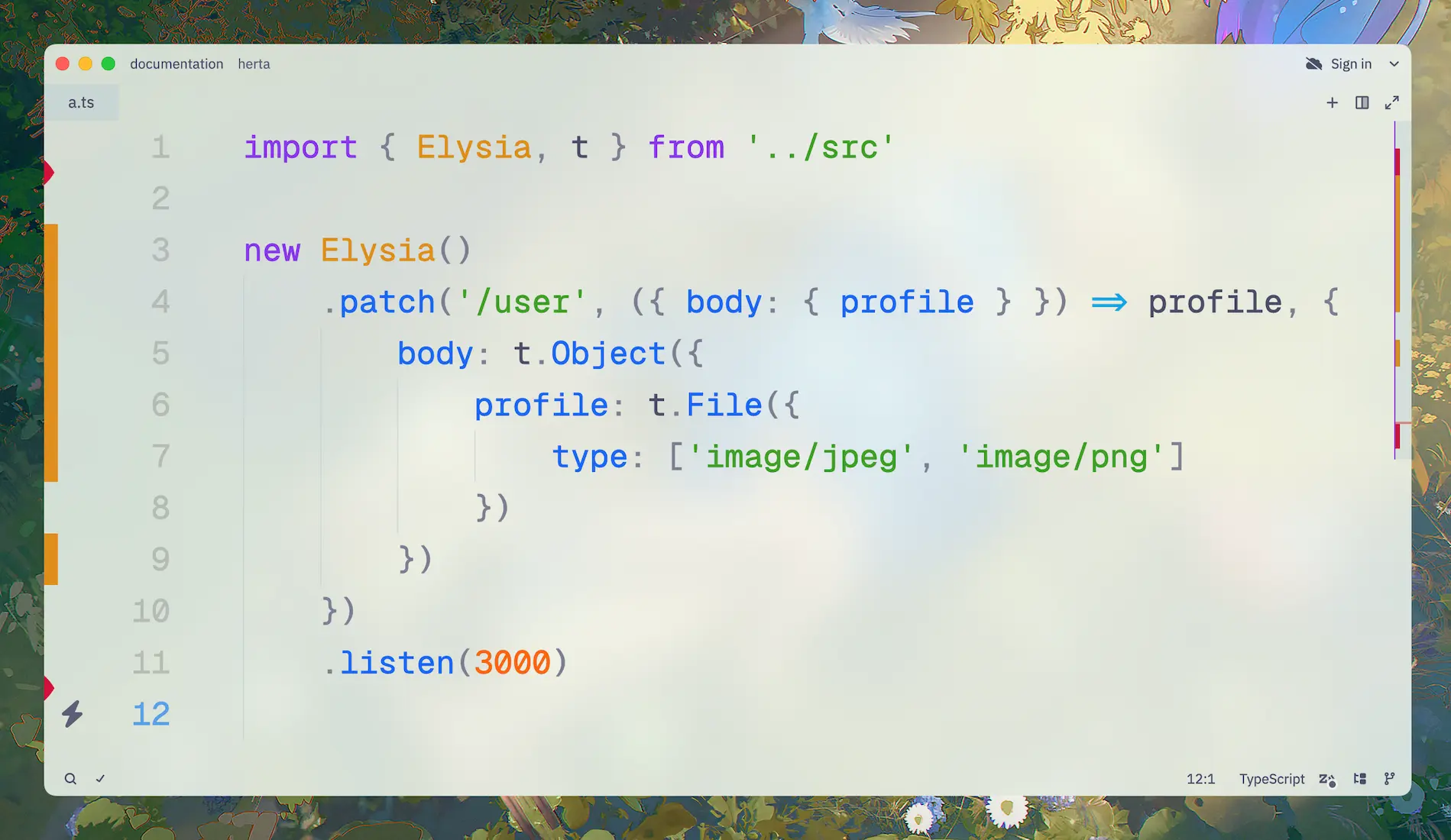
Defining file type using t.File
Once type is specified, Elysia will automatically detect file type by checking magic number.
However, it’s also listed as peerDependencies and not installed with Elysia by default to reduce bundle size for users who don’t need it.
It’s recommended to update to Elysia 1.3 if you rely on file type validation for better security.
Elysia.Ref
We can create a reference model by using Elysia.model and reference it with a name.
Sometimes we need to reference it inside a schema.
We can do just that by using Elysia.Ref to reference the model with auto‑completion.
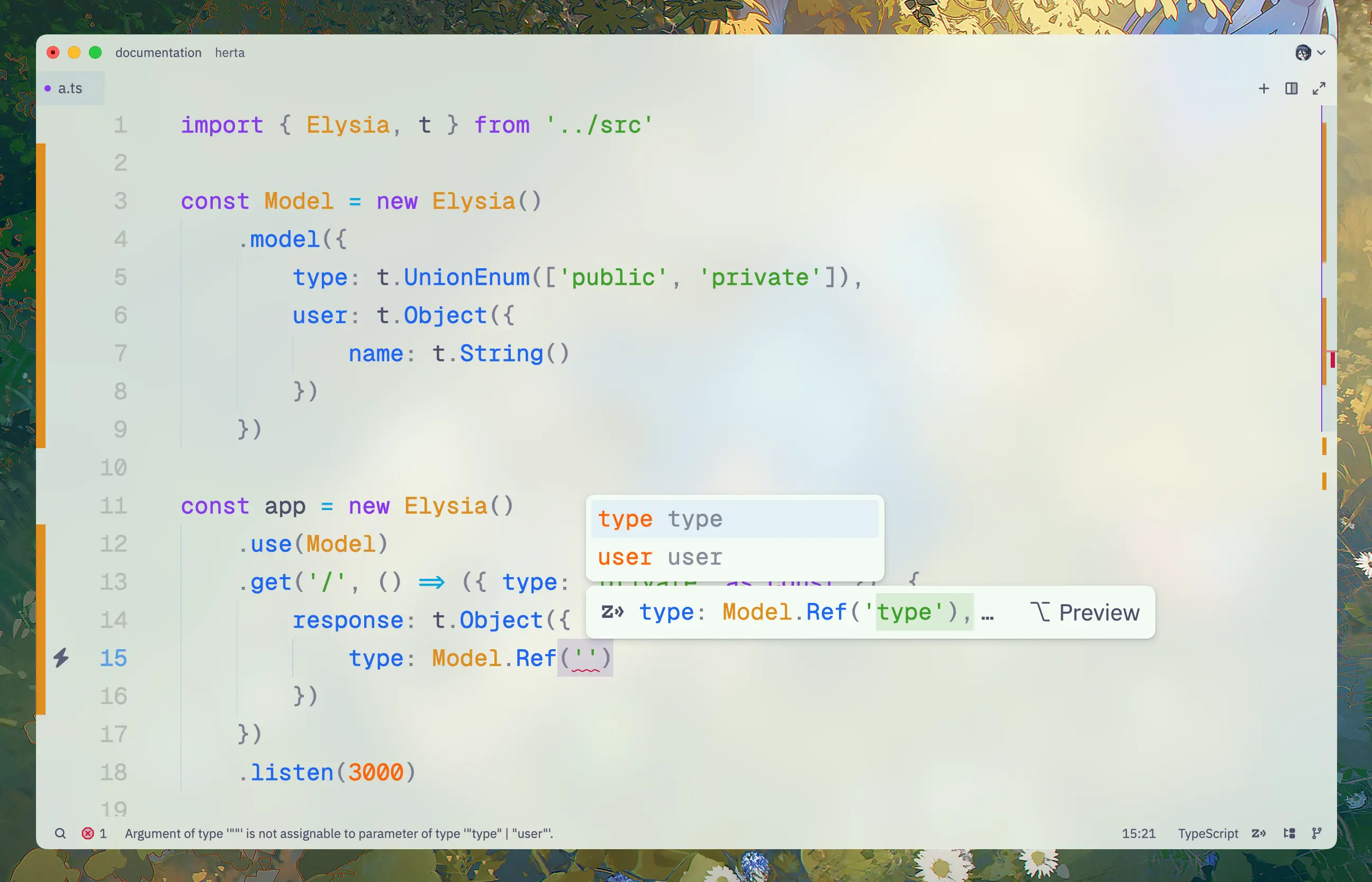
Using Elysia.Ref to reference model
You can also use t.Ref to reference a model, but it wouldn’t provide auto‑completion.
NoValidate
We received some feedback that some users want to quickly prototype their API or sometimes have problems enforcing validation.
In Elysia 1.3, we introduced t.NoValidate to skip validation.
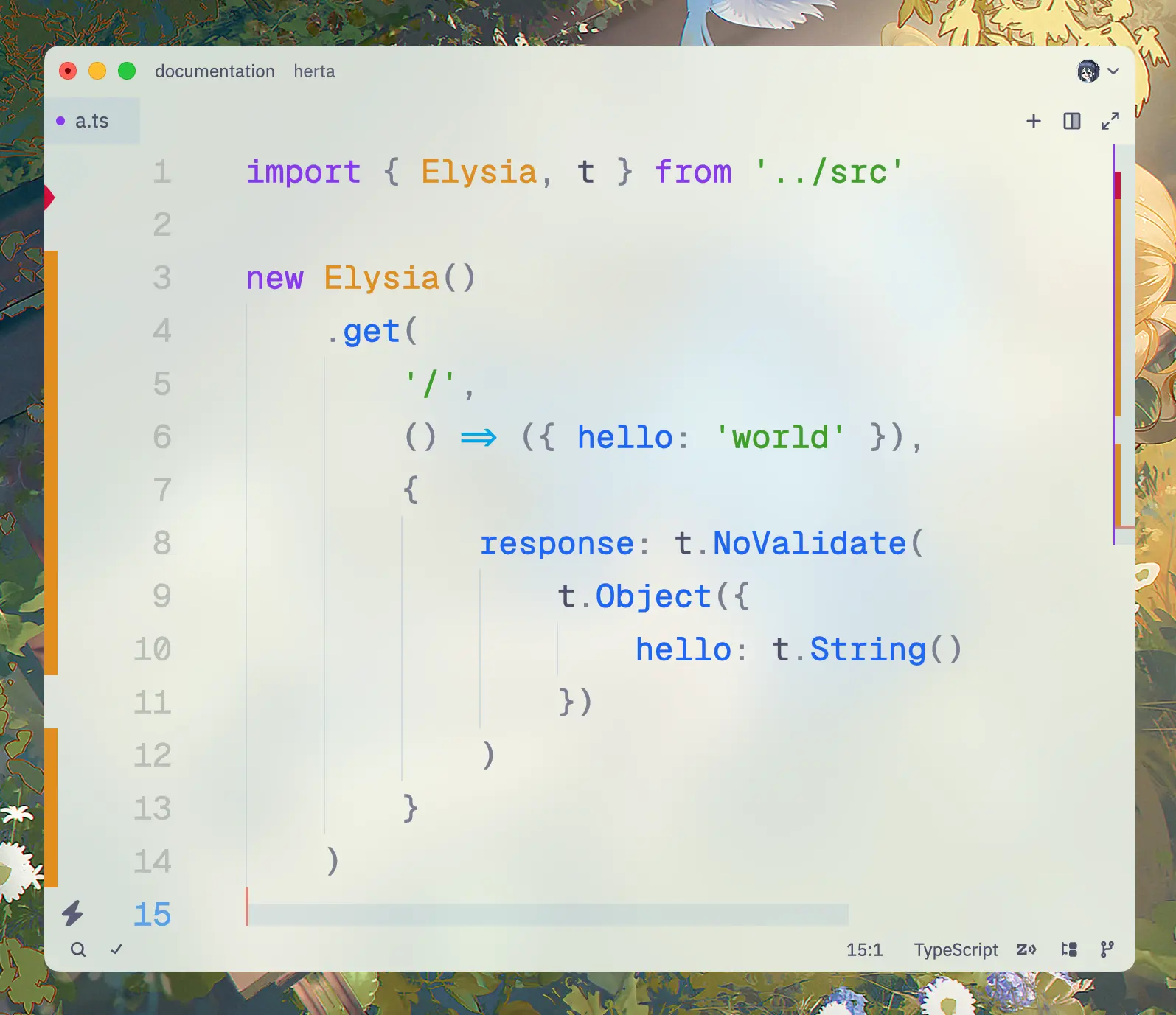
Using t.NoValidate to tell Elysia to skip validation
This will tell Elysia to skip runtime validation but still provide TypeScript type checking and OpenAPI schema for API documentation.
Status
We have received a lot of responses about the naming of error.
Starting with Elysia 1.3, we decided to deprecate error, and recommend using status instead.
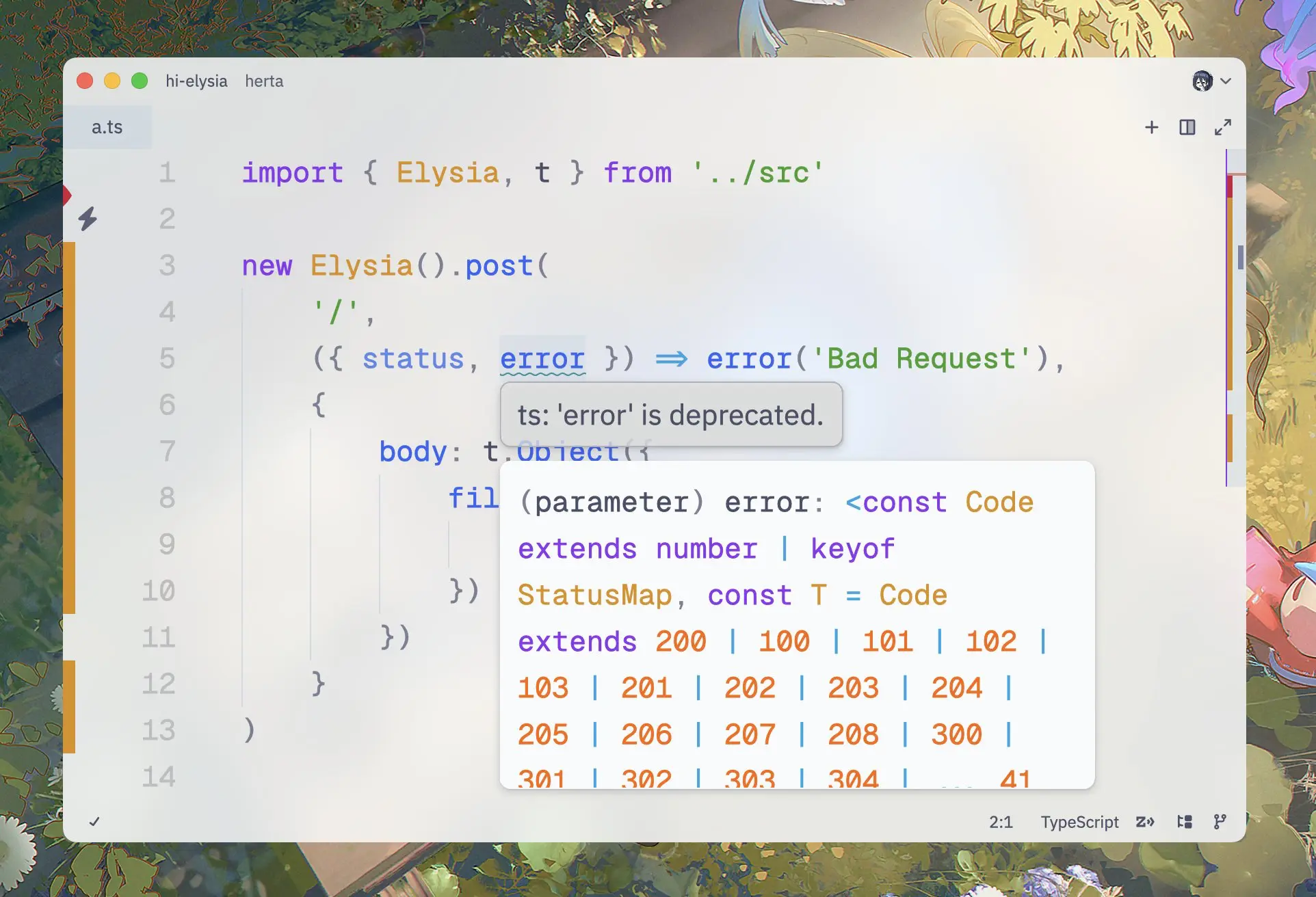
IDE showing that error is deprecated and renamed to status
The error function will work as it is in the previous version, with no immediate changes required.
However, we recommend refactoring to status as we will support error for at least the next six months or until around Elysia 1.4 or 1.5.
To migrate, simply rename error to status.
“.index” is removed from Treaty
Previously, you had to add (treaty).index to handle paths that end with /.
Starting with Elysia 1.3, we decided to drop the use of .index and can simply bypass it to call the method directly.
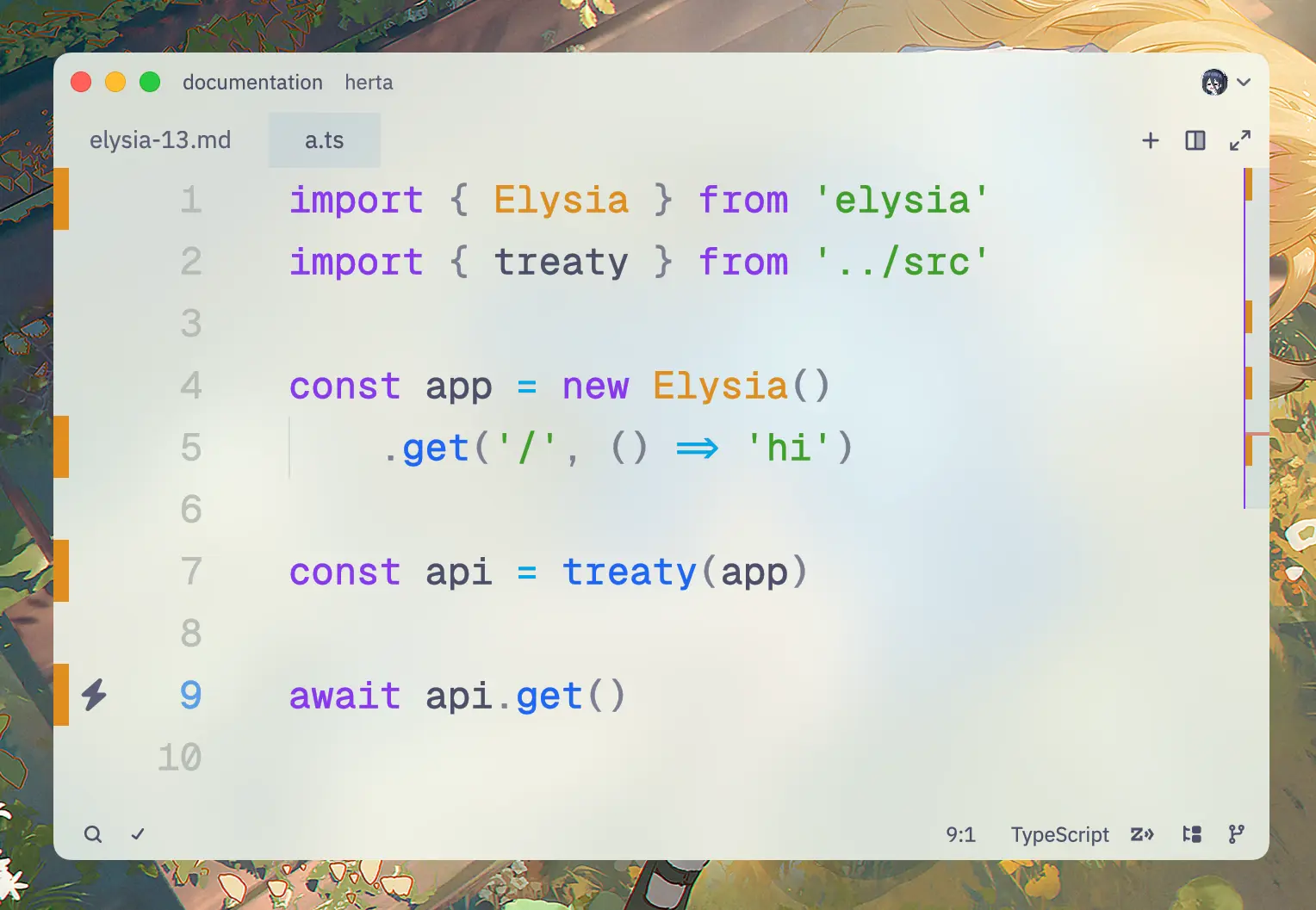
Eden Treaty showing no-use of .index
This is a breaking change but should require minimal effort to migrate.
To migrate, simply remove .index from your codebase. This should be a simple change by using IDE search to bulk‑change-and‑replace by matching .index to remove it.
Notable changes
Here are some notable changes from the changelog.
Improvement
encodeSchemanow stable and enabled by default- optimize types
- reduce redundant type check when using Encode
- optimize isAsync
- unwrap
Definition['typebox']by default to prevent unnecessaryUnwrapTypeModulecall Elysia.formcan now be type‑checked- refactor type‑system
- refactor
_typesinto~Types - using AOT compilation to check for custom Elysia type, eg.
Numeric - refactor
app.router.static, and move static router code generation to compile phase - optimize memory usage on
add,_use, and some utility functions - improve startup time on multiple routes
- dynamically create cookie validator as needed in compilation process
- reduce object cloning
- optimize start index for finding delimiter of a content type header
Promisecan now be a static responseParseErrornow keeps stack trace- refactor
parseQueryandparseQueryFromURL - add
configoptions tomount - recompile automatically after async modules are mounted
- support macro on when hook has function
- support resolve macro on ws
- #1146 add support to return web API’s File from handler
- #1165 skip non‑numeric status codes in response schema validation
- #1177 cookie does not sign when an error is thrown
Bug fix
Responsereturned fromonErroris using octet stream- unintentional memory allocation when using
mergeObjectArray - handle empty space on Date query
Change
- only provide
c.requestto mapResponse whenmaybeStreamis true - use plain object for
routeTreeinstead ofMap - remove
compressHistoryHookanddecompressHistoryHook - webstandard handler now returns
text/plainif not on Bun - use non‑const value for
decorateunless explicitly specified Elysia.mountnow setsdetail.hide = trueby default
Breaking Change
- remove
as('plugin')in favor ofas('scoped') - remove root
indexfor Eden Treaty - remove
websocketfromElysiaAdapter - remove
inference.request
Afterword
Hi? It’s been a while.
Life can be confusing, isn’t it?
One day you’re chasing your dream, working hard toward it.
Before you know it, you look back and realize that you are far ahead of your goal.
Someone looks up to you, and you become their inspiration. A role‑model for someone.
It sounds amazing, right?
But I don’t think I would be a good role‑model for others.
Sometimes, things just get exaggerated.
I may appear I’m a genius who can create anything but I’m not. I just try my best.
I hang out playing video games with friends, listening to weird songs, and watching movies. I even meet my friends at cosplay conventions.
Just like a normal person. All this time, I’ve just been hugging tightly to your arm.
I’m just like you, nothing special.
I try my best but I also act like a fool from time to time.
Even if I don’t think I have anything that makes me a role‑model, I want you to let me say that I’m grateful.
My boring and slightly lonely life, please don’t beautify it too much.
~ I’m glad you’re evil too.